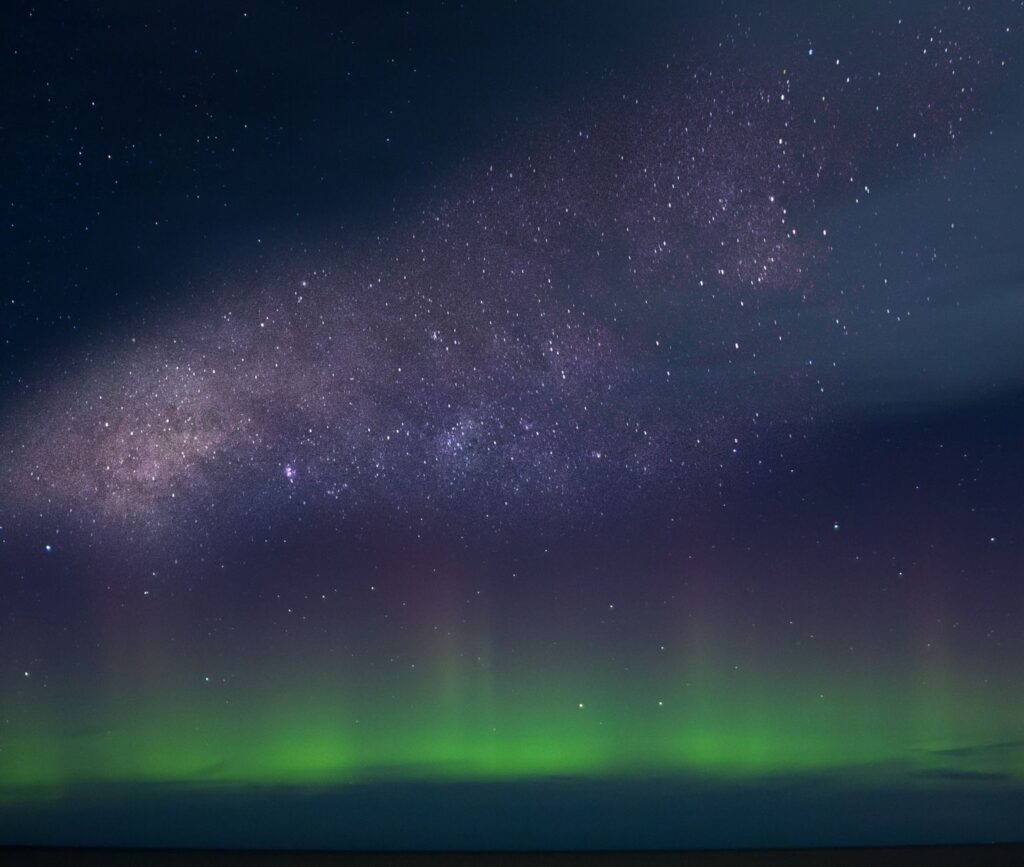

Milky Way versus Aurora showcases the breathtaking contrast between these two natural wonders. Understanding their unique characteristics enhances our appreciation for the cosmos.
Understanding the Milky Way
The Milky Way is a barred spiral galaxy that contains billions of stars, with our solar system situated in one of its outer arms. It is not just a collection of stars, but a vast system encompassing star clusters, nebulae, and dark matter. When observed from Earth, the Milky Way presents a stunning band of light stretching across the night sky, composed of countless distant stars. This phenomenon is particularly visible in areas with minimal light pollution, where the galaxy’s beauty can be fully appreciated.
One interesting aspect of the Milky Way is its dynamic nature. It is constantly evolving, with new stars being born while others reach the end of their life cycles. This contrasts with the more ephemeral beauty of the auroras, which are atmospheric phenomena caused by solar winds interacting with Earth’s magnetic field. While both the Milky Way and auroras captivate observers, they represent different aspects of our universe.
To fully understand the Milky Way, it helps to explore its various components:
- Stars: The fundamental building blocks of our galaxy.
- Nebulae: Regions where new stars are born.
- Dark Matter: An invisible substance that makes up a significant portion of the galaxy’s mass.
In summary, the Milky Way versus aurora comparison highlights the distinct yet magnificent features of our universe.
What Causes the Aurora?
The aurora, a stunning natural light display, is caused by the interaction of charged particles from the sun with the Earth’s magnetic field and atmosphere. As these particles, primarily electrons and protons, travel toward Earth, they collide with gases in the atmosphere, such as oxygen and nitrogen.
When these collisions occur, energy is released in the form of light, creating the vibrant colors we associate with auroras. The specific colors produced depend on the type of gas involved and the altitude of the collisions:
- Green: The most common color, resulting from oxygen at lower altitudes (around 100 km).
- Red: Also produced by oxygen but at much higher altitudes (above 200 km).
- Purple and blue: These colors arise from nitrogen, typically at lower altitudes.
While the Milky Way presents a breathtaking backdrop of stars and galactic structures, the aurora adds a dynamic and colorful element to the night sky. Observing the Milky Way versus aurora offers a unique perspective on the beauty of our universe. Both phenomena remind us of the intricate interactions between cosmic and terrestrial forces, illustrating the wonder of our celestial surroundings.
Comparing Night Sky Phenomena
When it comes to breathtaking night sky phenomena, the Milky Way and the Aurora are two of the most captivating displays one can witness. Each offers a unique experience, and comparing these celestial wonders reveals their distinct characteristics.
The Milky Way is a vast spiral galaxy that can be observed as a luminous band stretching across the night sky. It consists of billions of stars, along with gas and dust, creating a stunning visual effect. Observing the Milky Way is best done in dark locations, away from city lights, especially during the summer months when it is most prominent.
In contrast, the Aurora, often referred to as the Northern or Southern Lights, is a natural light display caused by the interaction of solar winds with Earth’s magnetic field. This phenomenon usually appears in vibrant greens, reds, and purples, illuminating the night sky in a dynamic dance of colors. The best time to see the Aurora is during winter months in polar regions, where the nights are longest and darkest.
Both the Milky Way and Aurora provide photographers and stargazers with incredible opportunities to capture the beauty of our universe. Ultimately, the choice between these two phenomena often comes down to personal preference and location.
Photographing the Milky Way and Aurora
Photographing the Milky Way and Aurora can be a thrilling experience for both amateur and professional photographers. Each celestial phenomenon offers unique challenges and opportunities for stunning visuals.
To capture the Milky Way, it’s essential to find a location with minimal light pollution. Photographers typically use a wide-angle lens to encompass the vastness of the galaxy. Key tips for shooting the Milky Way include:
- Use a tripod: Stability is crucial for long exposure shots.
- Set a high ISO: This enhances sensitivity to light, allowing for brighter images.
- Opt for a wide aperture: A lens with a wide f-stop captures more light.
- Shoot in RAW: This format retains more detail for post-processing.
In contrast, photographing the Aurora requires a different approach. While dark locations are still necessary, the dynamic nature of the auroras means timing and patience are key. Tips for capturing the Aurora include:
- Monitor aurora forecasts: This helps in planning your shoot.
- Use longer exposure times: This can reveal the beautiful movement of the lights.
- Incorporate foreground elements: Adding trees or mountains can enhance the composition.
Whether focusing on the Milky Way versus Aurora, both phenomena present opportunities for breathtaking photography.
The Science Behind Their Beauty
The beauty of the night sky is often a source of wonder and inspiration, with the Milky Way and the Aurora each showcasing unique characteristics that captivate observers. Understanding the science behind their beauty enhances our appreciation for these celestial phenomena.
The Milky Way, a barred spiral galaxy, is composed of billions of stars, gas, and dust, all held together by gravitational forces. Its stunning appearance is due to the concentration of stars in its galactic core, which creates a luminous band visible from Earth. Observers often find themselves mesmerized by its shimmering presence, especially on clear, dark nights.
On the other hand, the Aurora, often referred to as the Northern or Southern Lights, is a result of solar wind interacting with Earth’s magnetic field and atmosphere. Charged particles collide with gases in the atmosphere, creating vibrant displays of light in various colors. These displays are more prevalent near the poles, where the magnetic field is strongest.
Both the Milky Way and Aurora are influenced by natural forces, yet each tells a different story. The former reflects the vastness of space, while the latter illustrates the dynamic interactions of solar activity with our planet. Together, they offer a breathtaking comparison of the wonders of the universe.
In our exploration of the night sky, the “Milky Way versus Aurora” debate often arises among astrophotographers and enthusiasts alike. Understanding the unique beauty and characteristics of each phenomenon can help you appreciate the “Milky Way versus Aurora” comparison even more.
Photo by Pixabay on Pexels
Read the original
Related stories
RBI Officers Notification 2026-27: Quick and Clear Details · Galaxy S26 update: Best Simple Guide for One UI 9.5 Beta · Unity grant for indie developers: A smart opportunity worth $50K